Why We're Finally Seeing AI-Generated Technical Debt
AI didn't create technical debt. It accelerated the speed at which teams can create, hide, and discover it. The difference between success and failure is still engineering judgment.
AI-assisted development has evolved much faster than engineering practices.
Two years ago, AI mostly helped developers complete functions, generate boilerplate, and speed up repetitive tasks. Today, teams use AI to build entire features, services, and software components.
The code often looks clean. It follows conventions. It may even pass automated tests.
But software quality has never been about appearance alone.
Good software requires context, architecture, trade-offs, and clear intent. Those decisions cannot simply be generated, they need ownership.
The hidden problem: code without intent
The biggest risk is not that AI writes bad code.
The biggest risk is that teams accept code they don't fully understand.
When AI-generated changes look reasonable, it becomes tempting to merge them quickly. But important questions are often skipped:
- Does this solve the actual business problem?
- Did we introduce unnecessary complexity?
- Are we missing important edge cases?
- Does this fit the existing architecture?
- Will another engineer understand this six months from now?
When those questions stop being asked, technical debt starts accumulating quietly.
When AI becomes the reviewer of AI
The problem becomes even bigger when validation processes cannot keep up.
AI writes the code. AI helps create the tests. AI reviews the pull request.
Each step may look reasonable on its own, but weaknesses can compound when there is not enough human oversight.
The role of experienced engineers is not to manually write every line of code anymore. Their role is to provide judgment: understanding trade-offs, identifying risks, and ensuring the system is moving in the right direction.
Removing that judgment from the process creates a dangerous feedback loop.
The role of engineers is changing
The answer is not to slow down and manually review every line of AI-generated code forever. That approach will not scale.
The role of engineers is changing.
Developers will spend less time writing repetitive code and more time defining systems, reviewing decisions, validating outcomes, and owning the consequences.
AI can review code. It can find patterns. It can suggest improvements. It can identify many classes of bugs faster than humans.
But AI does not fully understand business context, long-term consequences, or the trade-offs behind architectural decisions.
A tool can tell you that a piece of code is complex. It cannot always tell you whether that complexity is justified.
It can suggest a refactor. It cannot know whether that change improves the system or simply moves the problem somewhere else.
The goal is not to remove AI from the development process.
The goal is to use AI while keeping humans responsible for the decisions that matter.
The cost appears later
Technical debt is rarely visible when it is created.
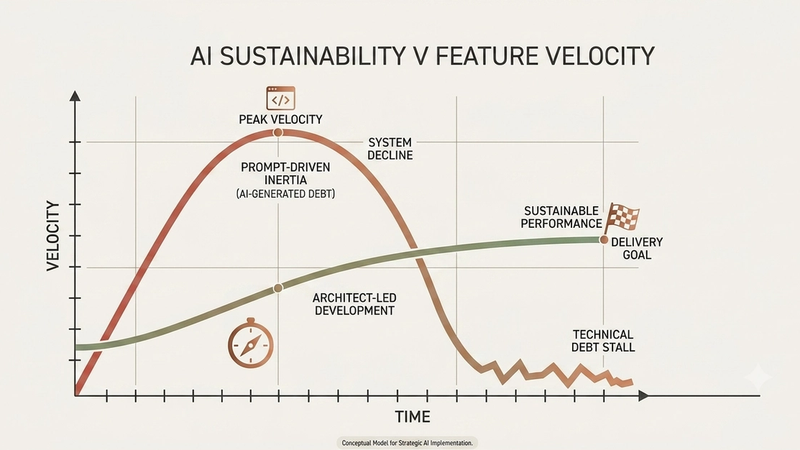
At first, everything looks fine. Features ship faster. Code reviews are shorter. The team feels more productive.
Then the bugs appear.
A developer investigates a problem and discovers a part of the system that nobody truly understands. The code may be technically correct, but the reasoning behind it is unclear.
Without human intent behind the design, debugging becomes much harder.
The team turns back to AI for help. Sometimes it works. Sometimes it creates another layer of complexity. The system becomes harder to reason about, and developers spend more time fixing generated solutions than building new capabilities.
Eventually, some projects reach a point where rewriting parts of the system becomes cheaper than continuing to patch it.
Delivery slows down. Confidence drops. The time saved earlier disappears through maintenance and recovery.
AI is not the problem
AI is not creating technical debt by itself.
Poor engineering practices are.
AI simply allows those practices to scale faster.
A team with strong engineering discipline can use AI to remove repetitive work, explore solutions faster, and deliver higher quality software.
A team without that discipline can use AI to produce more code than they can properly maintain.
The difference is not the tool.
The difference is the process around the tool.
The role of leadership
Removing engineering judgment from software development is a costly mistake.
If leadership believes AI is automatically better than their engineering team, they are misunderstanding the value of experienced developers.
The goal should not be replacing expertise.
The goal should be investing in expertise and giving engineers better tools.
Otherwise, organizations are not automating software development.. they are automating a mess.
The strongest teams will not be the ones that generate the most code.
They will be the ones that know what code should exist, why it should exist, and how to keep it maintainable.
The lesson
Replacing engineering skills with lazy prompting creates systems that are fast to build but expensive to fix.
AI is a powerful multiplier, but multipliers amplify what already exists.
Strong engineering practices become stronger.
Weak engineering practices become faster sources of technical debt.
The truth
AI is not a replacement for skilled developers.
The winning combination is AI plus experienced engineers who understand software design, business intent, architecture, and quality.
Fast and sloppy has always been easy.
Fast and excellent is the standard worth building toward.